

What is Vastu?
An ancient Indian science of design and architecture — the idea that your space influences your life, and that the arrangement of rooms, doors, direction of your bed, and color choices all matter.
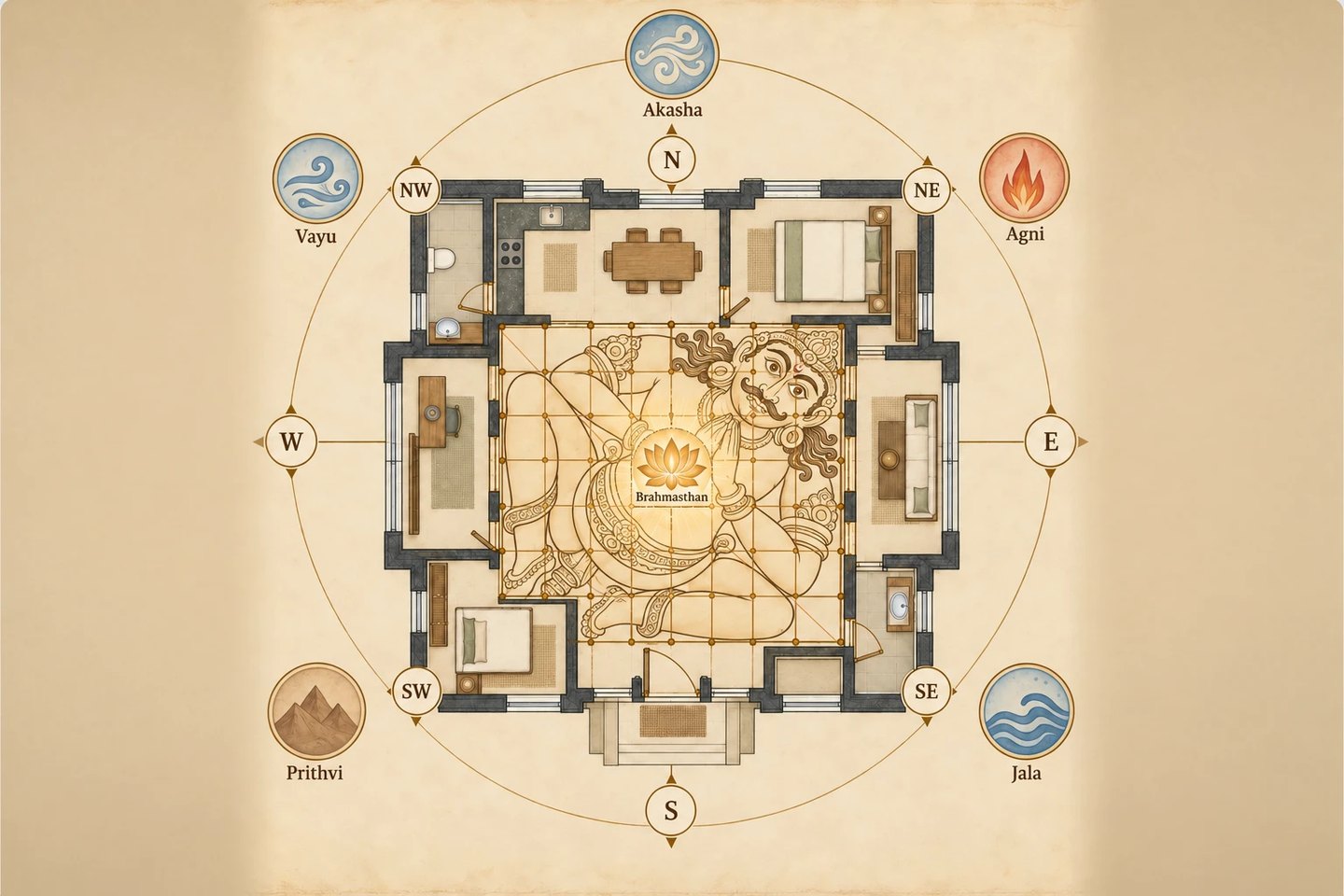
Vastu is a traditional design system. It connects direction, room use, circulation, light, and symbolic ideas about the five elements.
Use it as a structured way to review a home. Start with direction, room use, circulation, light, and the open center.
The Five Elements
Vastu works with five core elements. Each has properties and directions where it works best.
The Eight Directions
Each direction has distinct qualities and purposes.
| Direction | Character |
|---|---|
| North | Traditionally associated with growth, abundance, water, and Mercury. Some Vastu schools prefer north-facing entrances for work and trade. |
| Northeast | Traditionally associated with prosperity and spiritual practice. Many Vastu schools prefer a pooja room or meditation space here. |
| East | Traditionally associated with sunrise, beginnings, and activity. Many Vastu schools prefer entrances and daytime rooms here. |
| Southeast | Traditionally associated with fire and transformation. Many Vastu schools prefer the kitchen here. |
| South | Traditionally associated with stability, fire, and structure. Some Vastu schools prefer heavier furniture or a bedroom here. |
| Southwest | Traditionally associated with earth, stability, and rest. Many Vastu schools prefer the main bedroom here. |
| West | Completion and reflection. This is where the day ends — good for spaces of rest and guest areas. Too much west energy can create stagnation. |
| Northwest | Support and helpful connections. Air energy flows here — ideal for guest rooms and entry passages. It helps movement and transitions. |
Basic Principles
The Brahmasthan is Sacred. The center of your home is Brahmasthan. Keep this space open, clean, and uncluttered — this is where energy gathers. If it's blocked, energy can't flow.
Follow the Flow. Energy moves from northeast to southwest. Your entrance should ideally be in the northeast or east. Heavy elements go to the south and southwest; light elements go to the north and northeast.
Balance the Elements. Your space needs all five elements in harmony. A kitchen in the southeast (fire) needs water elements in the north to balance it. A bedroom in the south (earth) needs air circulation from windows in the east.
Review the entrance first. Many Vastu methods start with its direction and exact boundary position. See Part 6.
Make deliberate changes. Understand the traditional reason for a placement, then check practical needs such as access, light, ventilation, and safety.